
Concrete pumps did not arrive on jobsites as the machines we recognize today. They evolved through years of trial, mechanical ingenuity, difficult concrete mixes, hard lessons and feedback from the people standing beside the hopper. If you want to understand why modern pumps use the valves they do, it helps to listen to people who remember the earlier designs.
At JED Alliance, Edward and Jarol were discussing old concrete pumps when Edward asked a question that sounds simple but opens up decades of engineering history: Which came first—the early rock-style systems, the S-tube, or something else? Their conversation moved from crane buckets and squeeze pumps to Sidewinders, unusual hoppers, Schwing ROCK valves and the Putzmeister transfer tube. What follows combines those firsthand recollections with documented manufacturer milestones.
This is not a claim that every pump followed one single evolutionary path. Different manufacturers tried different solutions at overlapping times. Some designs became widespread; others remained specialized or faded from the mainstream.
Before modern concrete pumps: buckets, cranes and hard labor
Before pumped placement became routine, crews moved concrete with wheelbarrows, buckets, hoists and cranes. These methods could place material, but they required more handling and often more coordination between the truck, the crew and the location where concrete was needed.
When Edward asked what operators used before the pumps Jarol remembered, his immediate response was short: “Big crane buckets.” It is a small detail, but it captures why a reliable machine that could send concrete through a pipeline changed jobsite logistics so dramatically.
The challenge was never just moving concrete. A pumping system also had to manage a heavy, abrasive material that could segregate, wear components or block the line. That problem shaped nearly every early valve design.
Early designs: squeeze pumps, gate valves and trial-and-error engineering
The early decades featured several approaches rather than one universal machine. Squeeze-type pumps moved material by compressing a flexible hose; gate- and flapper-style arrangements redirected flow mechanically; piston systems pushed concrete through dedicated cylinders. Each approach brought trade-offs in pressure, aggregate handling, wear, cleaning and output.
Jarol recalled older squeeze machines as simple but limited compared with later high-output concrete pumps. His observation was not that the machines were useless. He pointed out that the same general pumping principle could remain practical in applications such as grout, plaster and other specialty materials, even when it was no longer the preferred answer for high-production structural concrete.
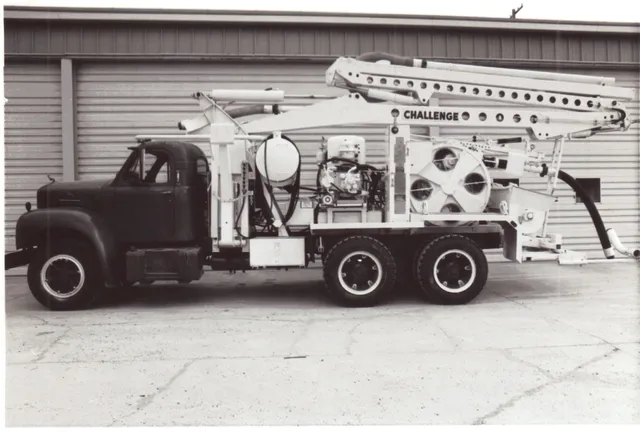
The old Challenge Squeeze-Crete truck in the photograph illustrates how far builders were willing to push these concepts—including mounting a placing boom on a truck rather than relying only on ground-level pipelines.
Technological evolution does not always mean total extinction. A squeeze-type pump can still make sense where its particular method of material delivery fits the job. The right question is not “Is this old technology?” but “What material, output and service conditions was this machine designed for?”
The “salad bowl” era—and the surprises inside the hopper
One of the most memorable parts of Edward and Jarol’s conversation concerned machines that operators called “salad bowls.” Jarol described an early arrangement with a tube moving outside the hopper as the mechanism switched from one concrete cylinder to the other. These are his recollections of a shop-floor nickname, not a verified manufacturer model designation.
He also remembered another bulky Y-shaped outlet arrangement that could shift the concrete suddenly from one side of the hopper to the other. A driver might see what looked like a full hopper, then discover on the next stroke that the material had moved—and splashed. Jarol summed up that experience with an operator’s verdict: “You are wearing it now.”
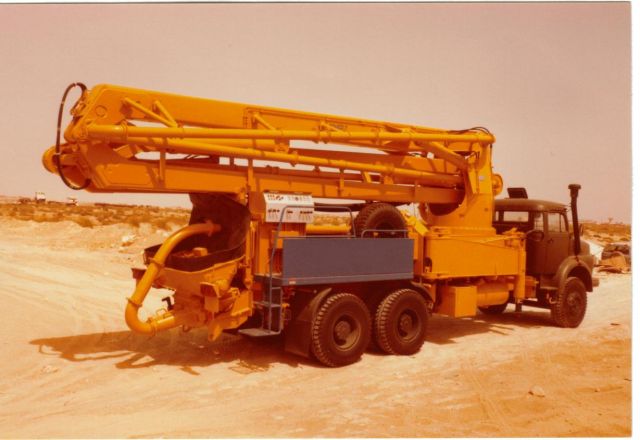
That story is more than color. It points to the problems manufacturers were trying to solve: smooth transfer between cylinders, predictable concrete movement and less downtime from awkward geometry or plugging. A valve could look inventive on a drawing but prove difficult when a ready-mix truck was waiting to discharge.
1957 onward: hydraulic two-cylinder pumping becomes a foundation
As pumps became more capable, the hydraulic two-cylinder layout took on a central role. According to Schwing’s published milestones, the company presented a production-ready oil-hydraulic, two-cylinder concrete pump in 1957. Schwing also documents a truck-mounted concrete pump in 1965, illustrating how quickly the technology expanded from the pump mechanism to the way concrete was delivered on the jobsite.
Two pumping cylinders working in alternation solved an important piece of the delivery problem. But the machine still needed a dependable way to switch the flow from one cylinder into the pipeline. That valve became one of the industry’s defining engineering challenges.
The years that followed were not a straight line from “primitive” to “modern.” Manufacturers were testing different valve geometry, hydraulic circuits, seals, hopper shapes and wear components—often at the same time.
1971: Putzmeister and the elephant-trunk C-transfer tube
Putzmeister’s own anniversary history identifies 1971 as a major turning point for its C-shaped transfer tube. Nicknamed the “elephant trunk” because of its curved profile, the tube swung in front of the pumping cylinders to connect the active cylinder to the delivery pipeline.
This mattered because a more direct concrete path and improved sealing could help overcome the restrictions and blockage issues associated with earlier flap or gate arrangements. Putzmeister later refined sealing around the transfer tube and wear ring as pressure requirements increased.
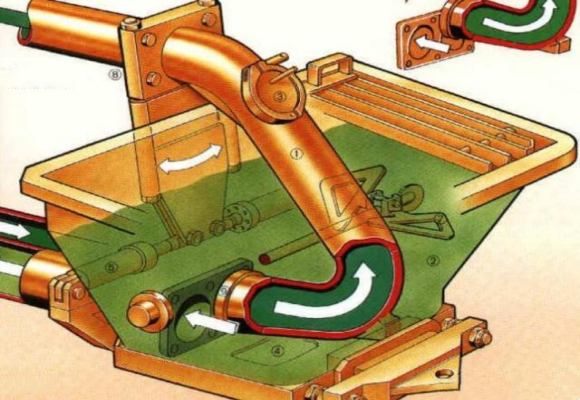
For an operator or mechanic, the larger lesson is easy to understand: a change inside the hopper can affect the entire job. If the valve guides concrete through the discharge with fewer interruptions and handles wear more effectively, the advantage appears in pumping consistency, cleaning and service intervals—not merely in a brochure specification.
1974–1975: the S-tube and the Sidewinder story
Here is a distinction worth getting right: Sidewinder was a pump name, not necessarily a competing valve principle. In its company history, Australian manufacturer Transcrete says it developed an S-tube prototype in 1974 and began production of the Sidewinder in 1975. That Sidewinder was itself an S-tube pump. Transcrete also describes subsequent distribution of the machine in the United States.
Jarol remembered seeing Sidewinders and older Thomsen/Thom-Katt-style equipment, sometimes with mechanical layouts so similar that the nameplate was one of the easiest ways to tell them apart. Those memories are valuable because operators often encounter a technology as a particular machine, not as a patent or engineering diagram.
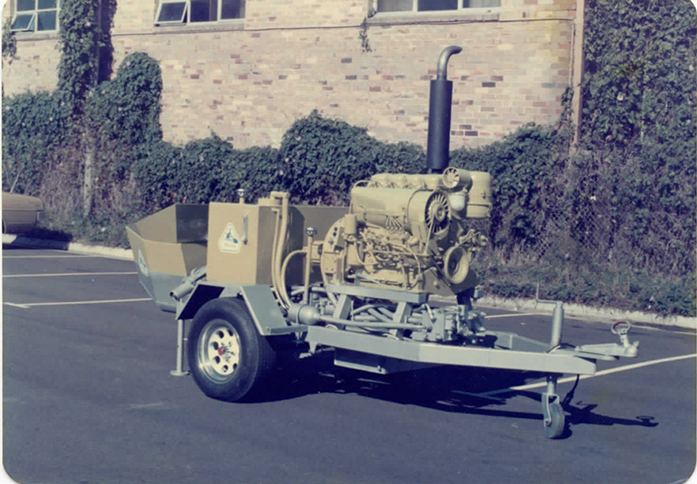
The wider advance was the idea of using a curved transfer tube to alternate between two concrete cylinders. That approach offered a path toward relatively direct material movement and a smaller set of core wear components than some earlier valve arrangements. Not every manufacturer introduced the concept in the same year, and the different S-tube families continued to evolve independently.
1983: Schwing introduces the ROCK valve
Schwing took a different route with its ROCK valve. Its documented milestones date the ROCK valve’s market introduction to 1983. According to Schwing, the design responded in part to wear problems experienced with earlier S-pipe development.
Schwing’s explanation emphasizes a particular wear-reduction principle: the valve’s geometry allows a protective region of concrete to form at a high-wear area, reducing direct abrasion of metal surfaces. The company also highlights access for cleaning and a reduced number of wear components.
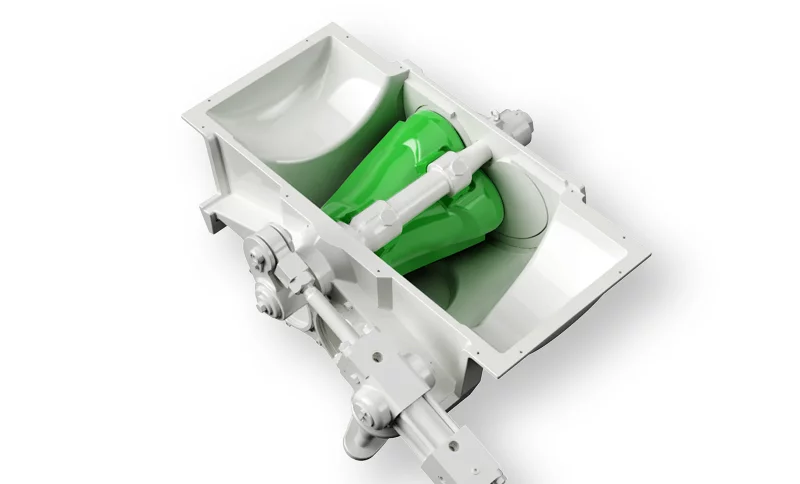
This is why a history of concrete pumps must make room for both the S-tube and the ROCK valve. They are not simply successive versions of the same part. They represent different, enduring approaches to the central challenge of moving abrasive concrete between pumping cylinders and the discharge line.
1985 and beyond: Putzmeister’s S-transfer tube becomes a lasting design
Although S-tube systems were already in use elsewhere during the 1970s, Putzmeister’s historical publications say it adopted the S-transfer tube on stationary concrete pumps from 1985 onward. Its current technical documentation continues to identify the S-transfer tube as the core arrangement in most of its concrete-pumping systems.
Over time, refinements to wear rings, spectacle plates, bearing assemblies and tube geometry improved the way these systems handle concrete and the way technicians service them. That continuing development matters just as much as the original invention: a machine can keep the same broad pumping principle while becoming substantially different in reliability, maintenance and control.
The 1990s to today: stronger pumps, better controls—and a respect for simplicity
As hydraulic systems, engines, boom designs and control systems developed, concrete pumps gained more choices in output, pressure and operation. Schwing’s company history, for example, dates its display-based VECTOR control system to 2004. Modern pumps may include remote controls, monitoring and more sophisticated switching systems, but that does not erase the value of understanding the basics.
Edward made this point while discussing older Schwing BPA 750 machines he had been picking up. He valued their rugged construction, serviceable diesel engines and uncomplicated mechanical arrangements. In his words, “You don’t have to hook up a computer to it.” That is an owner’s practical observation about particular older equipment—not a blanket claim that modern controls are inferior.
The appeal of a familiar pump is often very concrete: Can the crew get parts? Can a mechanic diagnose it? Does the valve clean easily? Does it pump consistently with the mixes the contractor actually uses? These questions are still being asked today, even as machines become more advanced.
What survived—and what the industry learned
The history of concrete pumping is not the story of one valve “winning everything.” Squeeze-type machines remain useful in certain specialized applications. S-transfer tubes are central to many Putzmeister designs and to other pump families. Schwing’s ROCK valve remains a defining system in its concrete pumps. Earlier gate, flapper and unusual outlet layouts helped expose the problems that later engineers worked to reduce.
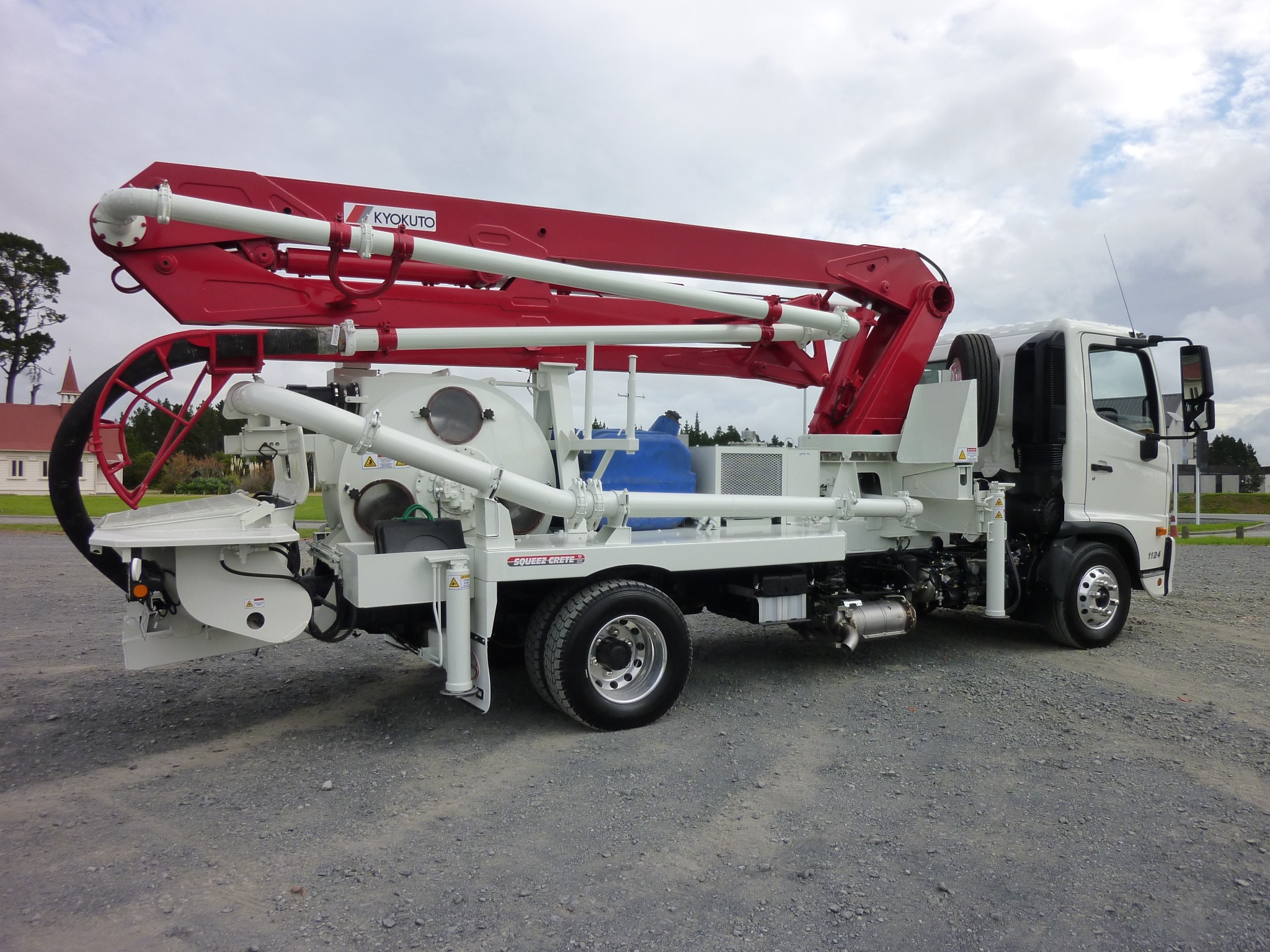
A modern hose-squeeze pump is an apt final photograph: an old principle still finding specialized work alongside the more familiar piston-pump designs. Progress in concrete pumping has meant choosing and refining the right tools, not replacing every older idea on the same day.
For Jarol, those changes are not a museum timeline. They are memories of hoppers, hydraulic parts, difficult cleanouts and crews dealing with the consequences of a poor design. For Edward, they connect directly to what a pump owner values decades later: serviceability, available parts and machinery that can earn its keep on a real jobsite.
That is the lesson behind the history of concrete pumps. The most important advances were not just about pumping farther or faster. They were about making the work more dependable for the people doing it.
Frequently asked questions about concrete pump history
When did hydraulic two-cylinder concrete pumps appear?
Schwing documents its production-ready hydraulic two-cylinder concrete pump in 1957. The broader development of concrete pumping involved many manufacturers and multiple overlapping designs.
Was the Sidewinder different from an S-tube pump?
Not always. Transcrete’s history specifically describes its 1975 Sidewinder as an S-tube pump. “Sidewinder” could refer to a machine line or a field nickname, so context matters.
What is the difference between a Schwing ROCK valve and a Putzmeister S-tube?
Both direct concrete between pumping cylinders and the discharge, but they do it with different valve geometry and wear-management approaches. This affects inspection, cleaning, repair methods and the associated wear parts.
Are squeeze pumps still used?
Yes, squeeze-type pumping remains useful in some specialized material-placement applications. However, its suitability depends on the material and required performance; it is not interchangeable with every modern high-output concrete pump.
Historical sources and further reading
Schwing-Stetter — Company Milestones; Schwing — ROCK Valve Technology; Putzmeister — 50 Years of Putzmeister (archival publication); Transcrete — History. Field recollections: Edward and Jarol, recorded conversation supplied to JED Alliance. Historical dates are attributed to the manufacturers; firsthand anecdotes reflect the speakers’ personal experiences.
